
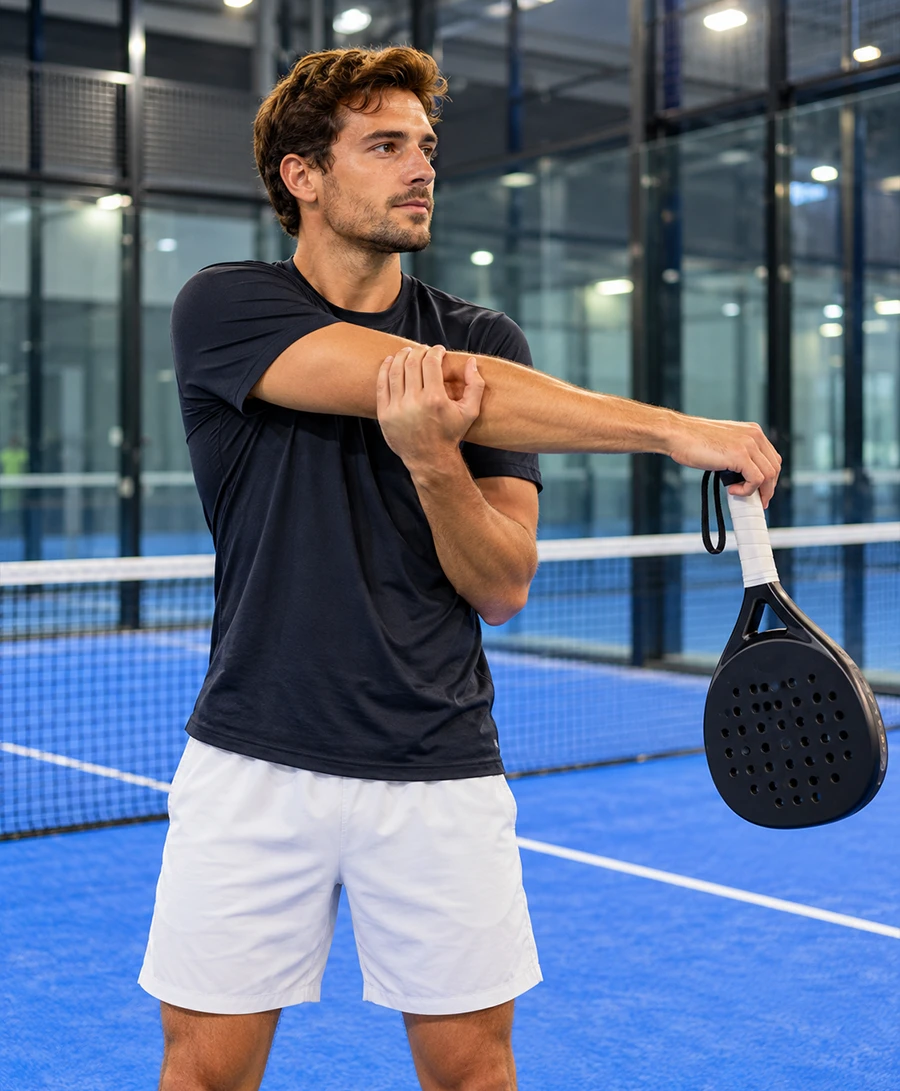
1. Padel Elbow: The One Everyone Asks About
Padel elbow is lateral epicondylitis, the same condition people call tennis elbow. It affects the tendons on the outside of the elbow that extend your wrist.
You’ll feel it as pain on the outer elbow, sometimes running down the forearm. It’s often worst when you grip something, lift a cup or shake hands, and it tends to be stiff in the morning.
What Usually Causes It
In our experience, it’s rarely one thing. It’s a combination of:
- The wrong racket. Many players buy a heavy, head-heavy diamond-shaped racket because a pro uses one. Those rackets are built for players who hit with perfect technique hundreds of times a day. For most club players, they’re simply too much for the forearm.
- A grip that’s too thin. A thin handle makes you squeeze harder on every shot.
- Squeezing all the time. Many players hold the racket as tight as they can from the first point to the last.
- Wristy strokes. Backhands and volleys hit with the wrist instead of the shoulder and body put all the load on those small tendons.
What We’d Recommend
Our honest advice: if you’re not an advanced player, choose a lighter, round-shaped racket with a softer core. It’s more forgiving, the sweet spot is bigger, and your elbow will thank you. You’ll lose a little power. You won’t miss it.
Then:
- Add an overgrip if the handle feels thin in your hand
- Keep your grip relaxed between shots and only firm it at contact
- Get a coach to look at your backhand and volley, since that’s where wristy habits hide
- Do slow wrist extension exercises with a light dumbbell a few times a week
2. Calf Strains and the Achilles
Calf strains are especially common in players over 30. They usually happen on an explosive push-off, like sprinting for a drop shot or turning to chase a lob. Players often describe it as feeling like someone kicked them in the back of the leg.
The Achilles tendon takes a beating too, from all those small, quick steps on the balls of the feet.
- Warm up your calves properly with skipping, light jogging and heel raises
- Strengthen them off the court with slow calf raises on a step, two or three times a week
- Drink enough water, especially on long evenings and tournament days
- Build up how often you play gradually
If you feel a sudden sharp pain or a pop in the calf and struggle to walk afterward, stop playing and get it checked. Playing through a calf strain almost always makes it worse.
3. Knee Pain
Low volleys, lunges and sudden changes of direction all load the knees. The two problems we hear about most are pain at the front of the knee from overloaded tendons, and twisting injuries when the foot stays planted while the body turns.
Shoes are the most overlooked factor here. We still see people playing in running shoes, and running shoes aren’t designed for sideways movement. Padel shoes with a herringbone or omni sole grip sand-filled turf without locking your foot in place.
- Replace your shoes once the sole pattern wears smooth
- Strengthen your thighs and hips with squats, lunges and glute work
- Get low by bending your hips and knees, not by reaching with straight legs
4. Ankle Sprains
Most ankle sprains we see happen when someone lands on a stray ball. It sounds silly, and it’s completely avoidable. Clear the loose balls before every point.
If you’ve sprained an ankle before, you’re more likely to do it again. Simple balance work, like standing on one leg while you brush your teeth, is worth the effort.
5. Shoulder and Lower Back
The smash, the bandeja, and the vibora all load the rotator cuff, the small muscles that hold the shoulder stable. Players who suddenly spend a month practicing overheads often feel it at the front or top of the shoulder first.
The lower back takes the rotation and the bending for low balls. Shoulder exercises with a light resistance band, plus planks and side planks for the core, go a long way. And use your legs to get low instead of folding at the waist.
Recovery Matters More Than You Think
If you’re increasing how much you play, leave at least one rest day between hard sessions. Sleep does more for tissue repair than any supplement. Pay attention to pain that hangs around for more than a day or two after playing, because that’s usually your body telling you the load went up too fast.
At Padel Kingdom Abu Dhabi, an on-site physio service is planned to open soon for players who want professional support.
Ready to step on court?
Choose your nearest Padel Kingdom branch and book your next session.